Saturday of the Twenty-ninth Week in Ordinary Time
Lectionary: 478
Reading 1
Brothers and sisters:
Grace was given to each of us
according to the measure of Christ’s gift.
Therefore, it says:
He ascended on high and took prisoners captive;
he gave gifts to men.
What does “he ascended” mean except that he also descended
into the lower regions of the earth?
The one who descended is also the one who ascended
far above all the heavens,
that he might fill all things.
And he gave some as Apostles, others as prophets,
others as evangelists, others as pastors and teachers,
to equip the holy ones for the work of ministry,
for building up the Body of Christ,
until we all attain to the unity of faith
and knowledge of the Son of God, to mature manhood
to the extent of the full stature of Christ,
so that we may no longer be infants,
tossed by waves and swept along by every wind of teaching
arising from human trickery,
from their cunning in the interests of deceitful scheming.
Rather, living the truth in love,
we should grow in every way into him who is the head, Christ,
from whom the whole Body,
joined and held together by every supporting ligament,
with the proper functioning of each part,
brings about the Body’s growth and builds itself up in love.
Responsorial Psalm
R. (1) Let us go rejoicing to the house of the Lord.
I rejoiced because they said to me,
“We will go up to the house of the LORD.”
And now we have set foot
within your gates, O Jerusalem.
R. Let us go rejoicing to the house of the Lord.
Jerusalem, built as a city
with compact unity.
To it the tribes go up,
the tribes of the LORD.
R. Let us go rejoicing to the house of the Lord.
According to the decree for Israel,
to give thanks to the name of the LORD.
In it are set up judgment seats,
seats for the house of David.
R. Let us go rejoicing to the house of the Lord.
Alleluia
R. Alleluia, alleluia.
I take no pleasure in the death of the wicked man, says the Lord,
but rather in his conversion that he may live.
R. Alleluia, alleluia.
Gospel
Some people told Jesus about the Galileans
whose blood Pilate had mingled with the blood of their sacrifices.
He said to them in reply,
“Do you think that because these Galileans suffered in this way
they were greater sinners than all other Galileans?
By no means!
But I tell you, if you do not repent,
you will all perish as they did!
Or those eighteen people who were killed
when the tower at Siloam fell on them–
do you think they were more guilty
than everyone else who lived in Jerusalem?
By no means!
But I tell you, if you do not repent,
you will all perish as they did!”
And he told them this parable:
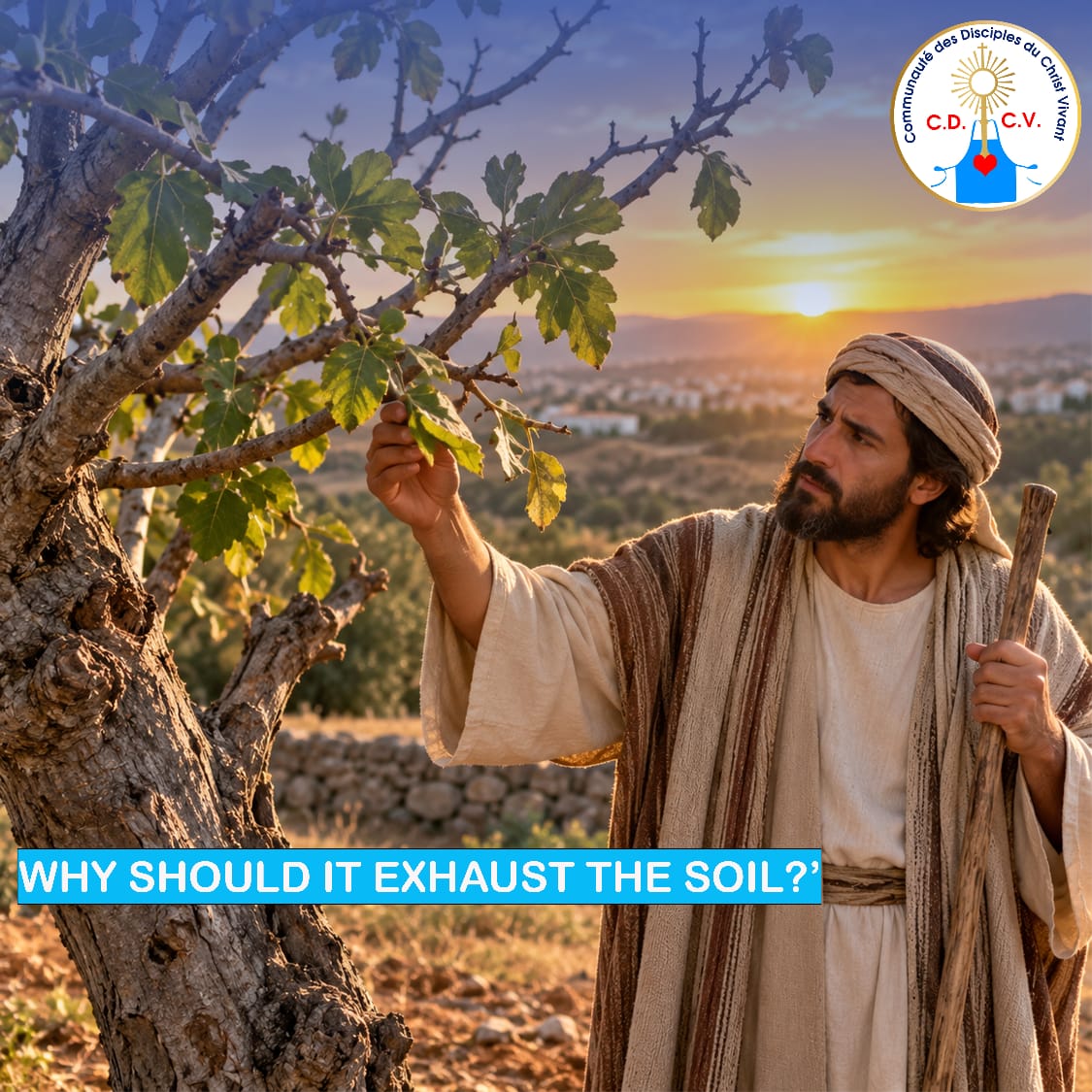
“There once was a person who had a fig tree planted in his orchard,
and when he came in search of fruit on it but found none,
he said to the gardener,
‘For three years now I have come in search of fruit on this fig tree
but have found none.
So cut it down.
Why should it exhaust the soil?’
He said to him in reply,
‘Sir, leave it for this year also,
and I shall cultivate the ground around it and fertilize it;
it may bear fruit in the future.
If not you can cut it down.’”
Meditation
“For three years now I have come in search of fruit on this fig tree but have found none.” (Lk 13:7)
Beloved in the Lord, may God be praised at all times! Too often, our selfishness makes us believe that we are the only ones expecting something from God. We want him to bless our plans, protect our health, and answer our prayers. When he does not satisfy our desires, we complain, our fervor fades, and our Christian commitment grows cold. But we must be careful: God, too, expects something of us. He created us to love him, serve him, and bear fruit for his glory and for the good of our brothers and sisters.
This is what Jesus teaches us in the parable of the barren fig tree (Lk 13:6–9). For three years, the owner comes looking for fruit on his tree and finds none. He then orders it to be cut down. But the gardener intercedes and obtains more time to cultivate the soil and fertilize it. That fig tree represents each one of us. God nourishes us with his Word, strengthens us through the sacraments, and raises us up through his mercy. Yet, despite so many graces, our lives can remain barren if we refuse to bring our actions into harmony with his will.
Is God pleased with our Christian life? What fruits does our faith produce? What becomes of the many times we receive the Eucharist? If God came today to gather fruit from the fig tree that we are, would he find love, patience, forgiveness, justice, and charity? Or would he find only religious practices that transform neither our hearts nor our relationships? Christian fruitfulness is measured not only by how often we receive Communion, but also by the concrete love that Communion nurtures within us.
Yet this parable is not merely a warning; it also reveals God’s patience. The gardener asks for more time to care for the tree. Likewise, the Lord offers us another opportunity for conversion today. Let us not use his patience as an excuse to postpone change until tomorrow. Instead, let us ask what we are doing with the graces we have received and how we are taking part in proclaiming the Gospel and serving others.
Finally, we cannot bear good fruit by our own strength alone. Jesus reveals the secret: “Whoever remains in me and I in him will bear much fruit” (Jn 15:5). Let us therefore remain united to Christ through prayer, listening to his Word, the sacraments, and daily conversion. May our lives be not merely well-tended fig trees, but trees that bear fruit for God and for our brothers and sisters.
Let us pray
God our Father, we praise you for the gift of life and for the graces you shower upon us. Forgive our lukewarmness and selfishness, and all the times we have expected so much from you without seeking to do your will. Through Jesus Christ, your Son, transform our hearts. May your Word guide our choices, may the Eucharist nourish our charity, and may your Holy Spirit increase in us love, patience, and faithfulness. Teach us to welcome each day as an opportunity for conversion and to bear fruit for your glory. Through Jesus Christ our Lord. Amen.
Intercession
Lord Jesus, you call us to remain in you. We entrust to you Christians whose faith has grown cold: rekindle their desire to love and serve you. We pray for those who receive the sacraments yet struggle to change their lives: may the graces they receive become acts of charity. Raise up those discouraged by their spiritual failures and renew their hope. Make our communities places of living faith, fellowship, and service. Lord, help us bear fruit that lasts. Amen.
Siritual exercise
Today, let us take a few minutes to ask ourselves: “If God came looking for fruit in my life, what would he find?” Let us identify one area where our faith bears little fruit: forgiveness, charity, justice, prayer, or service. Before this evening, let us perform one concrete act that will help us bear fruit in that area. Then let us thank God for his patience and ask for the strength to persevere.
My resolution
I no longer want to receive God’s graces without making them fruitful. Today, I choose to perform one concrete act of love and faithfulness.
André Kamta Sabang
Community of the Disciples of the Living Christ