Tuesday of the Twentieth Week in Ordinary Time
Reading 1
Ezekiel 28:1-10
The word of the LORD came to me: Son of man,
say to the prince of Tyre:
Thus says the Lord GOD:
Because you are haughty of heart,
you say, “A god am I!
I occupy a godly throne
in the heart of the sea!”—
And yet you are a man, and not a god,
however you may think yourself like a god.
Oh yes, you are wiser than Daniel,
there is no secret that is beyond you.
By your wisdom and your intelligence
you have made riches for yourself;
You have put gold and silver
into your treasuries.
By your great wisdom applied to your trading
you have heaped up your riches;
your heart has grown haughty from your riches–
therefore thus says the Lord GOD:
Because you have thought yourself
to have the mind of a god,
Therefore I will bring against you
foreigners, the most barbarous of nations.
They shall draw their swords
against your beauteous wisdom,
they shall run them through your splendid apparel.
They shall thrust you down to the pit, there to die
a bloodied corpse, in the heart of the sea.
Will you then say, “I am a god!”
when you face your murderers?
No, you are man, not a god,
handed over to those who will slay you.
You shall die the death of the uncircumcised
at the hands of foreigners,
for I have spoken, says the Lord GOD.
Responsorial Psalm
Deuteronomy 32:26-27ab, 27cd-28, 30, 35cd-36ab
R. (39c) It is I who deal death and give life.
“I would have said, ‘I will make an end of them
and blot out their name from men’s memories,’
Had I not feared the insolence of their enemies,
feared that these foes would mistakenly boast.”
R. It is I who deal death and give life.
“‘Our own hand won the victory;
the LORD had nothing to do with it.’”
For they are a people devoid of reason,
having no understanding.
R. It is I who deal death and give life.
“How could one man rout a thousand,
or two men put ten thousand to flight,
Unless it was because their Rock sold them
and the LORD delivered them up?”
R. It is I who deal death and give life.
Close at hand is the day of their disaster,
and their doom is rushing upon them!
Surely, the LORD shall do justice for his people;
on his servants he shall have pity.
R. It is I who deal death and give life.
Alleluia
2 Corinthians 8:9
R. Alleluia, alleluia.
Jesus Christ became poor although he was rich
So that by his poverty you might become rich.
R. Alleluia, alleluia.
Gospel
Matthew 19:23-30
Jesus said to his disciples:
“Amen, I say to you, it will be hard for one who is rich
to enter the Kingdom of heaven.
Again I say to you,
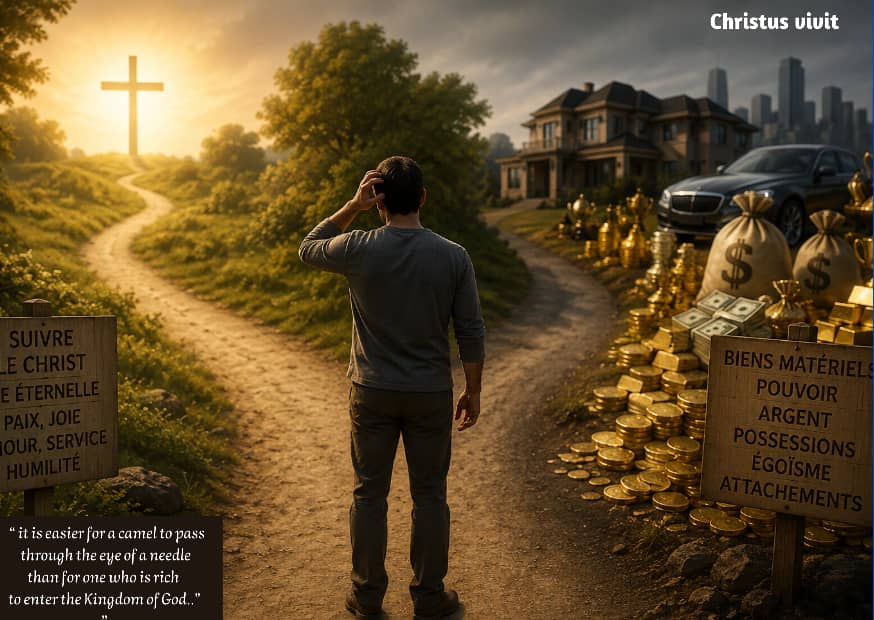
it is easier for a camel to pass through the eye of a needle
than for one who is rich to enter the Kingdom of God.”
When the disciples heard this, they were greatly astonished and said,
“Who then can be saved?”
Jesus looked at them and said,
“For men this is impossible,
but for God all things are possible.”
Then Peter said to him in reply,
“We have given up everything and followed you.
What will there be for us?”
Jesus said to them, “Amen, I say to you
that you who have followed me, in the new age,
when the Son of Man is seated on his throne of glory,
will yourselves sit on twelve thrones,
judging the twelve tribes of Israel.
And everyone who has given up houses or brothers or sisters
or father or mother or children or lands
for the sake of my name will receive a hundred times more,
and will inherit eternal life.
But many who are first will be last, and the last will be first.”
Meditation
Beloved in the Lord,
Blessed be God, who gives us life and fills us with His grace.
As we read the passages the liturgy offers us today, particularly the Gospel, we may find ourselves asking whether we ultimately need to be poor in order to enter the Kingdom of Heaven.
In the first reading, God pronounces, through the prophet Ezekiel, a judgment against the prince of Tyre. In the Gospel, Jesus declares that it will be difficult for a rich person to enter the Kingdom of Heaven. Is Jesus therefore against wealth? Does He want us to live in poverty and misery? Is wealth incompatible with eternal life? When reading this Gospel, many might be tempted to believe that Jesus condemns wealth in itself. Yet He, who came so that we may have life in abundance, does not condemn the possessions we have. Rather, He warns us about what these possessions can produce in our hearts when they take the place of God.
The first reading helps us understand this: “Your heart has become proud, and you have said, ‘I am a god; I sit on a divine throne in the heart of the seas.’ Yet you are a man, not a god, though you consider yourself as wise as a god.” The sin of the prince of Tyre was not simply that he possessed wealth. His tragedy was that he allowed his riches, power, and success to exalt his heart to the point of forgetting that he was only a human being. He eventually attributed to his own power what he had received. He came to believe that he was self-sufficient. He no longer needed God. This is one of the great dangers of wealth and power: forgetting the Source.
As we accumulate possessions, we can eventually begin to believe that everything comes from us: our intelligence, our talents, our achievements, our position, our possessions, and our influence. Little by little, they may take God’s place in our own hearts. The problem, therefore, is not only what we possess, but what possesses us. We can have many possessions while still having a free, generous, and humble heart. And we can possess very little while being deeply attached to the little we have.
How can we escape the trap of wealth?
The Gospel takes us towards a path: leaving everything behind to follow Jesus.
But “leaving everything behind” does not necessarily mean materially abandoning everything we possess. First and foremost, it means becoming internally free from attachment to all things, so that nothing takes God’s place in our hearts. This is what the principle of “indifference” in Ignatian spirituality reminds us of: we should not seek wealth rather than poverty, health rather than sickness, honour rather than dishonour, or a long life rather than a short one. Instead, we should desire and choose whatever leads us more fully towards the purpose for which we were created. To leave everything behind, therefore, is to be able to say to God: “Lord, everything I have comes from You. Everything I am comes from You. And everything I have, I want to place at Your service.”
Our possessions then cease to be masters and become instruments. Everything God entrusts to us can become an instrument of love and service. The second path is humility: recognizing that God is the source of every good thing and the author of every grace. If we have received talents, intelligence, possessions, responsibilities, or success, we can work diligently and acknowledge our efforts, but we must never forget that life itself, our abilities, and the opportunities given to us remain gifts. We can therefore ask ourselves today:
- When we accomplish something good, are we able to give thanks to God?
- When others praise and applaud us, do we know, deep within our hearts, how to give that glory back to the Lord?
- Do our possessions bring us closer to God and to others, or do they cause us to become self-centred?
- Are we rich for God, or merely rich for ourselves?
Let Us Pray
Lord, grant us the grace of a pure, free, and humble heart. Teach us to recognize that every good thing comes from You and to give You thanks for the gifts You entrust to us. Protect us from pride, self-sufficiency, and the idolatry of wealth.
Intercession
We pray for all those who desire to follow You to the very end: grant them the grace of inner freedom and spiritual indifference, so that they may always choose what leads them more fully towards You.
Mother Mary, humble and poor in heart, pray for us.
Spiritual Exercise
Today, let us take time to give thanks to God for every gift we have received: a talent, a person, an achievement, a material possession, or a particular grace. For each one, let us simply say:
“Lord, this comes from You. May it serve Your glory and the good of my brothers and sisters.”
KAMTA Flora (Community of the Disciples of the Living Christ)