Lectionary: 460
Reading 1
Job answered the LORD and said:
I know that you can do all things,
and that no purpose of yours can be hindered.
I have dealt with great things that I do not understand;
things too wonderful for me, which I cannot know.
I had heard of you by word of mouth,
but now my eye has seen you.
Therefore I disown what I have said,
and repent in dust and ashes.
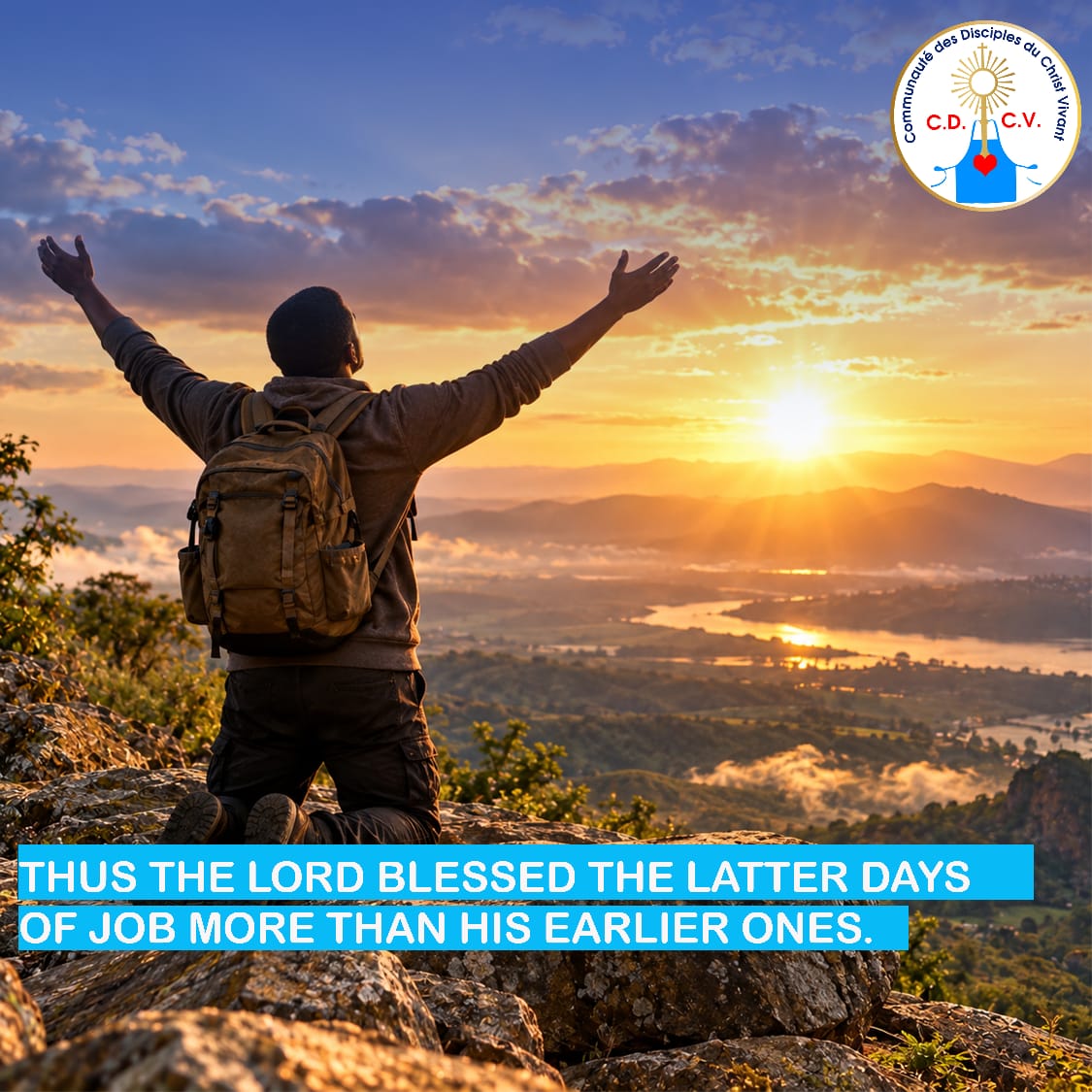
Thus the LORD blessed the latter days of Job
more than his earlier ones.
For he had fourteen thousand sheep, six thousand camels,
a thousand yoke of oxen, and a thousand she-asses.
And he had seven sons and three daughters,
of whom he called the first Jemimah,
the second Keziah, and the third Kerenhappuch.
In all the land no other women were as beautiful
as the daughters of Job;
and their father gave them an inheritance
along with their brothers.
After this, Job lived a hundred and forty years;
and he saw his children, his grandchildren,
and even his great-grandchildren.
Then Job died, old and full of years.
Responsorial Psalm
Psalm 119:66, 71, 75, 91, 125, 130
R. (135) Lord, let your face shine on me.
Teach me wisdom and knowledge,
for in your commands I trust.
R. Lord, let your face shine on me.
It is good for me that I have been afflicted,
that I may learn your statutes.
R. Lord, let your face shine on me.
I know, O LORD, that your ordinances are just,
and in your faithfulness you have afflicted me.
R. Lord, let your face shine on me.
According to your ordinances they still stand firm:
all things serve you.
R. Lord, let your face shine on me.
I am your servant; give me discernment
that I may know your decrees.
R. Lord, let your face shine on me.
The revelation of your words sheds light,
giving understanding to the simple.
R. Lord, let your face shine on me.
Alleluia
R. Alleluia, alleluia.
Blessed are you, Father, Lord of heaven and earth,
you have revealed to little ones the mysteries of the Kingdom.
R. Alleluia, alleluia.
Gospel
The seventy-two disciples returned rejoicing and said to Jesus,
“Lord, even the demons are subject to us because of your name.”
Jesus said, “I have observed Satan fall like lightning from the sky.
Behold, I have given you the power
‘to tread upon serpents’ and scorpions
and upon the full force of the enemy
and nothing will harm you.
Nevertheless, do not rejoice because the spirits are subject to you,
but rejoice because your names are written in heaven.
”At that very moment he rejoiced in the Holy Spirit and said,
“I give you praise, Father, Lord of heaven and earth,
for although you have hidden these things
from the wise and the learned
you have revealed them to the childlike.
Yes, Father, such has been your gracious will.
All things have been handed over to me by my Father.
No one knows who the Son is except the Father,
and who the Father is except the Son
and anyone to whom the Son wishes to reveal him.”
Turning to the disciples in private he said,
“Blessed are the eyes that see what you see.
For I say to you,
many prophets and kings desired to see what you see,
but did not see it,
and to hear what you hear, but did not hear it.”
Meditation
Beloved in the Lord, may God be praised at all times!
When we love God, when we have placed our faith and hope in him, we know one thing: trials will not have the final word.
Suffering may last. It may disrupt our plans. It may make us weep. It may even lead us to ask God questions for which we do not immediately find answers. But for the person who remains attached to God, trials are never the end of the story.
The first reading presents precisely the conclusion of Job’s human and spiritual experience.
Job had lost everything: his possessions, his children, and his health. He had gone from abundance to destitution and had experienced such deep suffering that he even came to curse the day of his birth.
Job questioned God. Job cried out in his pain. Job sought to understand. We should therefore not present his faith as an absence of complaints or questions. His greatness lies rather in the fact that, in the midst of his questions, he never completely broke his relationship with God.
He suffers before God. He weeps before God. He questions God. He complains before God. But he continues to speak to God. And this is already an extraordinary lesson for us.
Beloved, when we suffer, we may not understand God. We may even ask him difficult questions. But let us never stop speaking to him. For suffering becomes even more terrible when, in addition to suffering, we deliberately cut ourselves off from the One in whom we can find consolation, strength, and hope.
To whom shall we go? Who will give us the hope that can carry us even through death?This is why Job’s great victory is perhaps not simply that he recovered his possessions. His great victory is that he emerged from his trial with a deeper knowledge of God. He finally says: “I had heard of you by the hearing of the ear, but now my eye sees you.”
The trial that could have destroyed his relationship with God mysteriously became the place of a deeper encounter with him. And in the end, God restores Job and blesses him abundantly.
But we must be careful. The Book of Job does not teach us an automatic formula according to which every faithful person will necessarily recover twice what he or she has lost here on earth. Our Christian hope is greater than that.
There are illnesses from which some people do not recover in this life. There are people who die young despite their faith. There are couples who deeply desire a child and may never have a biological child. There are wounds whose consequences remain with us for a long time.
So how can we still say that trials do not have the final word? Because our hope does not rest only on the earthly conclusion of Job’s story. It rests above all on Jesus Christ, crucified and risen.
Let us contemplate Jesus during his Passion. He suffers terribly. He experiences abandonment. He is humiliated. He is crucified. And yet, in the very heart of this suffering, his relationship with the Father remains: “Father, into your hands I commend my spirit.”
This is the secret. The Cross was terrible, but the Cross was not the last page of Jesus’ story. After Good Friday came Easter morning. After the Cross came the Resurrection. After the tomb came Life. This is why a Christian can suffer without despairing.
Not because he necessarily knows when his trial will end. Not because he necessarily knows how God will intervene. But because he knows with whom he is going through the trial.
Beloved, if you are suffering now, perhaps you have been carrying this trial for a long time. You pray. You wait. You hope. And nothing seems to change. Perhaps you keep asking: “Lord, when will this end?”
That question is legitimate. But today, let us add another: “Lord, while I wait for this trial to end, what is becoming of my relationship with you?” Do I still love you? Do I still pray? Do I still trust you? Or has my trial gradually become greater in my heart than God himself?
This is the real battle. In suffering, let us watch over our faith. Let us watch over our hope. Above all, let us watch over our relationship with God.
To you who are facing illness, perhaps even an illness that medicine does not currently know how to cure, continue to seek serious medical care and support, but do not let illness steal your hope.
Pray. Seek treatment. Get the help you need. Surround yourself with people who love you. And remain with God.
Faith does not mean that God necessarily guarantees the physical healing we ask for. It means that, whether we are healed here on earth or not, we remain in his hands.
Jesus gives us a hope that goes even beyond healing: “I am the resurrection and the life. Whoever believes in me, even if he dies, will live.”
This is why even death no longer has the final word. To you also who have long desired a child and suffer because you do not have one, do not let this pain separate you from God.
Your suffering is real and deserves to be received with respect. Continue, whenever possible, with appropriate medical care. But do not reduce your entire capacity to love, to give life, and to bear fruit to the sole fact of having a biological child.
Look around you as well. There are children who need to be loved. Children who need guidance. Vulnerable children who need someone to be present for them.
According to each person’s possibilities and calling, there is education, sponsorship, mentoring, service to vulnerable children and, when the human and legal conditions are met, adoption.
This does not mean that these forms of service simply replace the desire to have one’s own child. That desire remains legitimate, and its non-fulfilment can be deeply painful. But our fruitfulness can take many forms.
I am thinking of a woman who had difficulty having a child.
Rather than allowing her whole life to become imprisoned by this suffering, she committed herself to serving children. She began by opening a daycare centre to help families in her neighbourhood. She welcomed and cared for the children with great love. Then she founded a nursery school, and later a primary school.
Together with her husband, she gradually devoted herself to the education of children. A few years later, they had the joy of welcoming a child of their own.
Let us give thanks to God for their story. But above all, let us remember this: even before that joyful outcome, their lives had already become fruitful.
They had not waited for their suffering to disappear before they began to love. And perhaps this is a word for each of us today: let us not necessarily wait for the trial to end before we begin to live, love, and serve again.
We can suffer and still love. We can wait and still serve. We can weep and continue to do good. We can fail to understand and continue to believe. We can go through a trial without allowing that trial to become our entire identity.
When we go through situations that seem hopeless, let us therefore not abandon God. Let us speak to him. Let us love him. Let us serve him. Let us allow him to sustain us.
And when we see no way out, let us look at the Cross. Good Friday seemed to be the end. The tomb seemed to have closed the story forever. But God still had another page to write.
That page was called Resurrection. This is our hope: with God, a trial may be a painful page in our story, but it is never the final word.
Let Us Pray
God our Father,
we come before you with our joys, but also with our wounds, our waiting, and our trials.
Through Jesus Christ, your Son, who passed through suffering and death before entering the glory of the Resurrection, grant that we may never lose hope.
When the trial lasts, sustain us. When we no longer understand, keep us close to you. When we weep, receive our tears. When we are tempted to give up everything, remind us that our story remains in your hands.
Give us the grace to continue loving while we wait, to continue serving while we suffer, and to continue believing when we cannot yet see the way out.
May trials never destroy our relationship with you. And when our strength fails, carry us yourself.
Through Jesus Christ our Lord, who died and rose again for us.
Amen.
Intercession
Lord Jesus,
you who knew suffering, anguish, and the Cross, look with compassion upon all those who are going through a trial today.
We entrust to you the sick, especially those living with a serious, chronic, or currently incurable illness: give them strength, surround them with loving people, and sustain those who care for them.
We entrust to you those who have long been waiting for healing, employment, reconciliation, or a solution to a difficult situation: preserve them from despair.
We entrust to you couples who desire to welcome a child and who are going through the trial of infertility: comfort them, guide them in their discernment, and preserve their love in peace and unity.
We entrust to you those who have lost a loved one and for whom no earthly restoration can replace the person who has died: deepen in them the hope of the Resurrection.
We entrust to you those whose faith has been weakened by their trials: do not allow their suffering to imprison them far from you.
Finally, we entrust to you all those who accompany people in times of trial: families, friends, priests, doctors, nurses, psychologists, and all caregivers.
Give them the right words, patience, and the compassion they need.
And give each of us, Lord Jesus, this certainty: no night is so deep that it can prevent God from leading his children toward the light.
Jesus, our hope, we trust in you. Amen.
Holy Mary, pray for us.
Spiritual Exercise
Today, let us practise the exercise of the next page.
Take a sheet of paper and write at the top: “My current trial.”
Then describe in one or two sentences what is causing you pain at the moment.
Next, write: “What this trial must not take away from me.”
Choose three things that you want to protect despite this difficulty: my faith; my prayer; my capacity to love; my joy; my service to others; my relationship with my family; my hope.
Then ask yourself this question: “What good can I still do today, even though my problem has not yet been resolved?”
And do one concrete act: call someone, visit someone, pray for someone, help a child, encourage someone who is discouraged, render a service, or resume an activity that you abandoned because of your sadness.
Finally, before God, say: “Lord, I do not yet know how this trial will end. But I refuse to let it prevent me from loving, believing, and doing good. Write the next page of my story with me.”
For we do not always choose the painful pages that enter our story. But with God, we can choose not to write the word END on them.
My resolution: I will not let my trial become my whole story. Today again, I will believe, love, and do good.
André Kamta Sabang
Community of the Disciples of the Living Christ