Daily Mass Readings – Saturday, 26 September 2026
First Reading: Ecclesiastes 11: 9 – 12: 8
9 Rejoice therefore, O young man, in thy youth, and let thy heart be in that which is good in the days of thy youth, and walk in the ways of thy heart, and in the sight of thy eyes: and know that for all these God will bring thee into judgment.
10 Remove anger from thy heart, and put away evil from thy flesh. For youth and pleasure are vain.
12:1 Remember thy Creator in the days of thy youth, before the time of affliction come, and the years draw nigh of which thou shalt say: They please me not:
2 Before the sun, and the light, and the moon, and the stars be darkened, and the clouds return after the rain:
3 When the keepers of the house shall tremble, and the strong men shall stagger, and the grinders shall be idle in a small number, and they that look through the holes shall be darkened:
4 And they shall shut the doors in the street, when the grinder’s voice shall be low, and they shall rise up at the voice of the bird, and all the daughters of music shall grow deaf.
5 And they shall fear high things, and they shall be afraid in the way, the almond tree shall flourish, the locust shall be made fat, and the caper tree shall be destroyed: because man shall go into the house of his eternity, and the mourners shall go round about in the street.
6 Before the silver cord be broken, and the golden fillet shrink back, and the pitcher be crushed at the fountain, and the wheel be broken upon the cistern,
7 And the dust return into its earth, from whence it was, and the spirit return to God, who gave it.
8 Vanity of vanities, said Ecclesiastes, and all things are vanity.
Responsorial Psalm: Psalms 90: 3-4, 5-6, 12-13, 14 and 17
R. (1) In every age, O Lord, you have been our refuge.
3 Turn not man away to be brought low: and thou hast said: Be converted, O ye sons of men.
4 For a thousand years in thy sight are as yesterday, which is past. And as a watch in the night,
R. In every age, O Lord, you have been our refuge.
5 Things that are counted nothing, shall their years be.
6 In the morning man shall grow up like grass; in the morning he shall flourish and pass away: in the evening he shall fall, grow dry, and wither.
R. In every age, O Lord, you have been our refuge.
12 Can number thy wrath? So make thy right hand known: and men learned in heart, in wisdom.
13 Return, O Lord, how long? and be entreated in favour of thy servants.
R. In every age, O Lord, you have been our refuge.
14 We are filled in the morning with thy mercy: and we have rejoiced, and are delighted all our days.
17 And let the brightness of the Lord our God be upon us: and direct thou the works of our hands over us; yea, the work of our hands do thou direct.
R. In every age, O Lord, you have been our refuge.
Alleluia: Second Timothy 1: 10
R. Alleluia, alleluia.
10 Our Savior Christ Jesus destroyed death and brought life to light through the Gospel.
R. Alleluia, alleluia.
Gospel: Luke 9: 43b-45
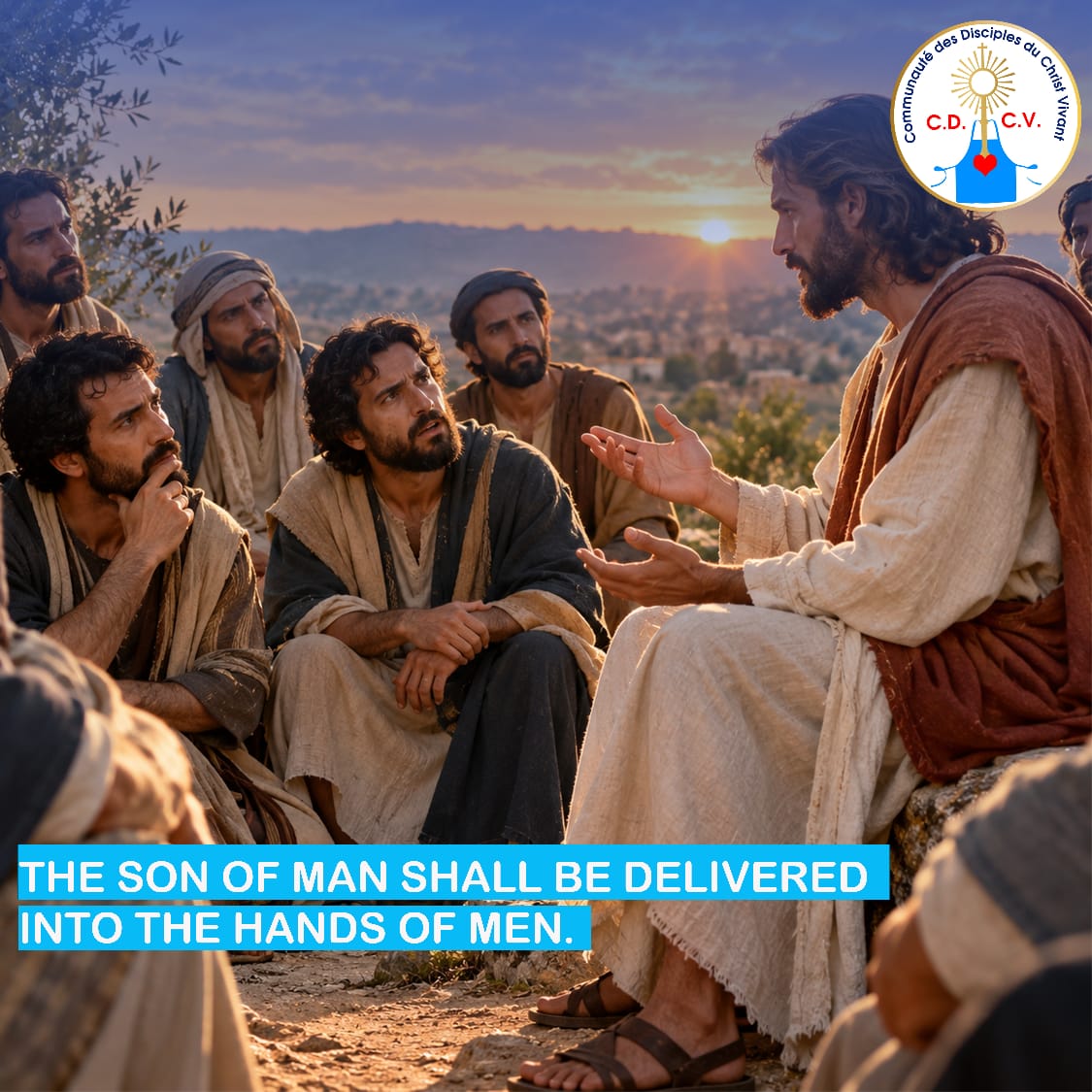
43b, 44 All were astonished at the mighty power of God. But while all wondered at all the things he did, he said to his disciples: Lay you up in your hearts these words, for it shall come to pass, that the Son of man shall be delivered into the hands of men.
45 But they understood not this word; and it was hid from them, so that they perceived it not. And they were afraid to ask him concerning this word.
Meditation
Beloved in the Lord, may God be praised at all times!
On this Saturday of the 25th Week in Ordinary Time, we commemorate Saints Cosmas and Damian, martyrs who are traditionally honoured as patron saints of physicians, surgeons, and pharmacists.
Saint Cosmas and Saint Damian were two brothers, traditionally believed to have been twins, physicians, and Christian martyrs who lived in the East during the third century. According to tradition, they treated the sick free of charge, out of love for Christ and their neighbour, without distinction of social status. This is why they are called the Holy Unmercenaries: they did not demand payment for the medical care they provided.
They suffered martyrdom during the persecutions against Christians traditionally associated with the time of Emperor Diocletian. Their lives therefore remind us that Christian faith can lead us to the total gift of ourselves.
But this self-giving does not lead only through glory; it also leads through the Cross. In the Gospel we have just heard, while everyone is amazed at everything Jesus is doing, he announces something completely unexpected: “The Son of Man is going to be delivered into the hands of men.” What a contrast!
The crowd is looking at the miracles; Jesus is already looking towards the Cross. The people admire his power; Jesus announces his humiliation. Everything seems to point towards triumph, yet Jesus speaks about his Passion. This means that, in order to truly understand who Jesus is, we must welcome not only the Christ who performs miracles, but also the Christ who walks the way of the Cross.
Admiration alone is not enough to become a disciple. Admiring Jesus when he heals, delivers, and works wonders is one thing; continuing to trust him when we walk with him through trials, waiting, or uncertainty is another. This Gospel therefore asks us a first question: Does our faith depend only on what God does according to our expectations?
When God answers my prayers, I believe. When things happen as I hoped, I praise God. When I can clearly see his action, I proclaim his faithfulness. But what happens to my faith when I no longer understand? When God seems silent? When my prayers do not receive the answer I expected? When the path God allows before me is not the one I had imagined?
It is precisely here that a deeper faith begins When Jesus announces his Passion, the disciples do not understand. The Gospel tells us: “They did not understand this saying; its meaning was hidden from them so that they could not grasp it.” This teaches us something important about our relationship with God: Not understanding everything does not necessarily mean not believing. The disciples follow Jesus, and yet they do not understand everything. They love him, but they do not understand everything. They have left many things behind for him, but they do not understand everything.
They have seen his miracles, listened to his teachings, and walked with him, and yet part of the mystery still escapes them. Faith, therefore, is not the immediate possession of all the answers. Faith is also a journey.There are things we believe today whose full depth we may only discover gradually. The disciples themselves would understand Jesus’ words more deeply after his death and Resurrection, when they looked back on these events in the light of Easter.
The same can happen in our own lives. Today, we may be going through a situation whose meaning we simply cannot understand. We may ask: “Lord, why?” And receive no immediate answer. We may read a passage from Scripture without being able to understand it.
We may even encounter questions in our faith for which we cannot immediately find a satisfactory answer. This does not necessarily mean that we have lost our faith. Faith can also mean saying: “Lord, I do not understand yet, but I remain with you.” What a beautiful expression of trust! I do not understand, but I remain. I cannot see clearly yet, but I continue to walk. I do not have all the answers, but I continue searching with God.
However, there is something in the attitude of the disciples that should particularly challenge us. They do not understand, but they are afraid to ask. The Gospel says: “They were afraid to ask him about this saying.” This may be the real problem. It is not simply that they do not understand.
It is the silence into which their fear locks their lack of understanding. They do not understand, and they do not dare to ask. The Gospel does not tell us exactly why they were afraid. We should therefore avoid claiming to know what the text does not tell us.
But their attitude leads us to examine ourselves: When I do not understand God, do I move away from him, or do I question him? That makes all the difference. Sometimes we have developed a strange understanding of faith, as though a good Christian should never have questions.
As though questioning God were already a lack of faith. As though we were expected to understand everything, accept everything immediately, and never say: “Lord, I do not understand.” Yet the Bible is filled with men and women who speak to God from the depths of their incomprehension.
The Psalms are filled with questions. Job asks questions. The prophets ask questions. Even on the Cross, Jesus takes up the cry of the Psalm: “My God, my God, why have you forsaken me?”
Faith, therefore, does not forbid questions. Rather, it teaches us where to take our questions. Instead of allowing my lack of understanding to drive me away from God, I can turn it into prayer. Instead of struggling alone with my questions, I can speak to the Lord.
Instead of immediately looking everywhere else for answers, I can begin by telling him: “Lord, I do not understand.” That sentence alone can already become a beautiful prayer. “Lord, I do not understand what is happening to me.” “I do not understand why this prayer remains unanswered.” “I do not understand this passage of the Gospel.” “I do not understand what you expect from me.” “I do not understand why you allow this situation.” And then I can add: “But I do not want to move away from you because of what I do not understand. Enlighten me and teach me to trust you.”
Beloved, let us therefore ask the Lord to lead us from a faith based merely on admiration to a deeper trust. A faith that does not depend only on miracles. A faith that does not disappear when answers are delayed. A faith that accepts the journey.A faith that seeks understanding. A faith that dares to question God without ceasing to love him. A faith capable of saying: “Lord, I do not understand yet, but I believe in you and I remain with you.” Because sometimes faith does not mean understanding everything. It means knowing with whom to remain when we no longer understand.
Let Us Pray
God our Father, we bless you for Jesus Christ, your Son, who reveals your love to us and leads us along the path of faith. Through him, grant us a humble and persevering faith. When we understand your ways, teach us to give you thanks. And when we no longer understand them, keep us close to you.
Deliver us from a faith that loves you only when everything happens according to our desires. Give us the grace to trust you in light as well as in darkness, in consolation as well as in trials.
When your Word is beyond our understanding, give us the desire to meditate upon it. When your ways trouble us, give us the courage to ask you our questions. When answers are delayed, give us the patience to wait for your light.
And when the Cross appears on our path, give us the grace to remain united with Christ without ever seeking suffering for its own sake. Through Jesus Christ our Lord. Amen.
Intercession
Lord Jesus, today we entrust to you all those who are going through the trial of not understanding.
We pray for those who no longer understand what is happening in their lives and who wonder where God is: strengthen their faith.
We pray for those whose prayers seem to remain unanswered: give them perseverance and peace.
We pray for those who are facing difficult questions about their faith: place on their path people who can listen to them and accompany them with truth and charity.
We pray for those who are suffering and searching for meaning in their trials: protect them from isolation and despair.
We especially entrust to you physicians, pharmacists, surgeons, nurses, and all healthcare professionals: following the example of Saints Cosmas and Damian, grant them the grace to serve every person with competence, compassion, and respect.
Finally, we entrust each one of us to you.
When we do not understand, Lord, teach us not to run away from your presence.
Give us the courage to come to you with our real questions.
And when we cannot yet understand, at least give us the grace to continue believing, loving, and walking with you. Jesus, I trust in you. Amen.
Holy Mary, pray for us.
Spiritual Exercise
Today, let us practise the exercise of placing our question before God. Let us identify one thing that we currently do not understand in our life or in our faith.
Just one: a situation, a trial, a passage from Scripture, an unanswered prayer, a difficult decision, or a question that we may have carried for a long time.
Then let us spend ten minutes in silence before God. Let us not immediately look for an explanation.
Let us simply tell the Lord, in our own words: “Lord, this is what I do not understand…”
And let us explain our difficulty to him as we would speak to someone who loves us.
Then let us end our prayer with these words: “Lord, I do not understand yet, but I refuse to move away from you because of what I do not understand. Enlighten me at the right time and, while I wait, teach me to trust you.”
If our question concerns faith or Scripture, let us also resolve to search seriously for an answer: by returning to the Word of God, consulting the teaching of the Church, or seeking guidance from someone competent.
For faith does not ask us to give up trying to understand. It teaches us to seek the light without abandoning God while we are searching for it.
My resolution: What I do not understand today will not become a reason to move away from God, but a reason to speak to him even more.
André KAMTA SABANG
Community of the Disciples of the Living Christ