Wednesday of the Twenty-second Week in Ordinary Time
Reading 1, 1 Corinthians 3:1-9
Brothers and sisters,
I could not talk to you as spiritual people,
but as fleshly people, as infants in Christ.
I fed you milk, not solid food,
because you were unable to take it.
Indeed, you are still not able, even now,
for you are still of the flesh.
While there is jealousy and rivalry among you,
are you not of the flesh, and walking
according to the manner of man?
Whenever someone says, “I belong to Paul,” and another,
“I belong to Apollos,” are you not merely men?
What is Apollos, after all, and what is Paul?
Ministers through whom you became believers,
just as the Lord assigned each one.
I planted, Apollos watered, but God caused the growth.
Therefore, neither the one who plants nor the one who waters is anything,
but only God, who causes the growth.
He who plants and he who waters are one,
and each will receive wages in proportion to his labor.
For we are God’s co-workers;
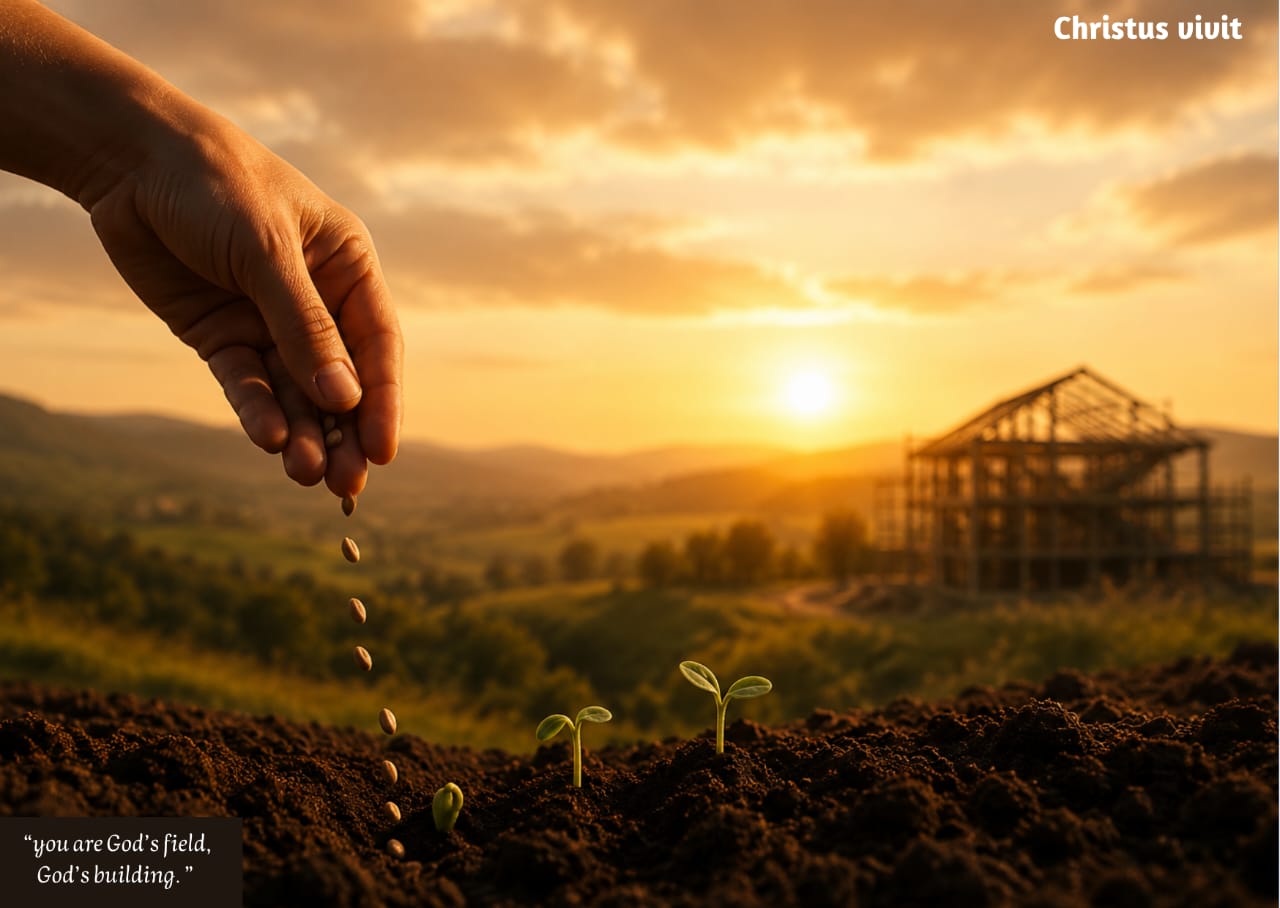
you are God’s field, God’s building.
Responsorial Psalm
Psalm 33:12-13, 14-15, 20-21
R. (12) Blessed the people the Lord has chosen to be his own.
Blessed the nation whose God is the LORD,
the people he has chosen for his own inheritance.
From heaven the LORD looks down;
he sees all mankind.
R. Blessed the people the Lord has chosen to be his own.
From his fixed throne he beholds
all who dwell on the earth,
He who fashioned the heart of each,
he who knows all their works.
R. Blessed the people the Lord has chosen to be his own.
Our soul waits for the LORD,
who is our help and our shield,
For in him our hearts rejoice;
in his holy name we trust.
R. Blessed the people the Lord has chosen to be his own.
Alleluia, Luke 4:18
R. Alleluia, alleluia.
The Lord sent me to bring glad tidings to the poor
and to proclaim liberty to captives.
R. Alleluia, alleluia.
Gospel, Luke 4:38-44
After Jesus left the synagogue, he entered the house of Simon.
Simon’s mother-in-law was afflicted with a severe fever,
and they interceded with him about her.
He stood over her, rebuked the fever, and it left her.
She got up immediately and waited on them.
At sunset, all who had people sick with various diseases
brought them to him.
He laid his hands on each of them and cured them.
And demons also came out from many, shouting, “You are the Son of God.”
But he rebuked them and did not allow them to speak
because they knew that he was the Christ.
At daybreak, Jesus left and went to a deserted place.
The crowds went looking for him, and when they came to him,
they tried to prevent him from leaving them.
But he said to them, “To the other towns also
I must proclaim the good news of the Kingdom of God,
because for this purpose I have been sent.”
And he was preaching in the synagogues of Judea.
Meditation
Brothers and sisters in the Lord Jesus Christ, let us give thanks to God for the gift of a new day.
When we speak about our relationship with God, we often ask ourselves the question: “Who is God to me?” We seek to define what God represents in our lives: our Father, our refuge, the One who loves us, and so on. But do we regularly take the time to ask ourselves how God sees us? What does He see in us? Who are we in His eyes? Today, the Word invites us to reflect on these questions.
Saint Paul, in this passage from his First Letter to the Corinthians, gives us a powerful answer through two images. He says: “You are God’s field, God’s building.” We are therefore a work in God’s hands. And as the greatest of all artists, God desires to make each one of us, who are His works, a masterpiece. People may play a role in our lives, and different situations may arise, but it is God who gives the growth.
We are not the result of chance. Our story—with its successes, wounds, delays, new beginnings, and struggles—is a place where God is at work. A field does not immediately produce fruit. It must be prepared, ploughed, watered, and patiently cultivated. Sometimes, weeds must be removed. A house is not built in a single day either. There are foundations, walls, and periods when we can hardly see any progress. In the same way, God is at work in us even when we cannot yet see the results of His work.
That being said, Saint Paul warns us against certain dangers: replacing God in our hearts with the people through whom He works in our lives, comparing our lives with those of others, and becoming jealous of other people’s progress. All these things steal our peace, prevent us from seeing the events of our lives from a spiritual perspective, and distract us from what truly matters. Saint Paul reminds us that God remains the master builder of our lives, and we do not need to be like someone else in order to be loved by Him.
Let us therefore take a moment of silence and ask ourselves:
- Do I truly see myself as a work of God?
- Do I believe that God is still at work in my life, even when I do not see any progress?
- With whom am I currently engaged in rivalry or competition?
- Who do I constantly compare myself to?
Let Us Pray:
Lord our God, We thank You for Your Word, which reminds us today that we are Your work. We recognize that You have entrusted us to brothers and sisters who have planted, watered, accompanied, advised, and encouraged us. We thank You for all the people through whom You have worked in our lives. Teach us to look beyond the instruments and recognize Your hand at work. Teach us to plant in the lives of others without seeking glory for ourselves. Make us a field that is docile and receptive in Your hands.
Amen.
Intercession
Let us pray for priests, religious men and women, catechists, leaders, parents, educators, and all those who work to help their brothers and sisters grow in faith or who have responsibility for the well-being of others. May the Holy Spirit help them never to forget that they are God’s co-workers and not the owners of His work.
Virgin Mary, intercede for them and for us!
Spiritual Exercise
Today, let us not seek to control the outcome of our actions. Let us do our part and entrust the rest to God. And whenever, during the day, we are tempted to compare ourselves with someone else, become jealous, or enter into rivalry, let us repeat inwardly:
“I am not in competition with my brother or sister. We are God’s co-workers. We are fields that God is cultivating.”
BEBISSI Stéphanie
Community of the Disciples of the Living Christ